
Moviefone Assets sold to Born In Cleveland, LLC

- Background: Moviefone, a subsidiary of Helios and Matheson Analytics, Inc., is an entertainment information and marketing service that delivers movie showtimes, trailers, TV schedules, streaming information, cast and crew interviews, and editorial coverage.
- Cassel Salpeter:
- Served as financial advisor to the Company
- Conducted a robust sales process, identifying and contacting a broad set of strategic and financial parties
- Provided assistance throughout all phases of the Chapter 7 Section 363 sales process, due diligence, and auctions
- Challenges:
- Moviefone was losing value over time due to limited attention and resources; the assets needed to be sold in a short time frame in order to preserve value
- Limited information and resources available at the Company
- Maximizing the value of the estate during a global pandemic
- Outcome: On March 19, 2020, the court approved the sale of the Moviefone assets to Born In Cleveland, LLC. Additional assets were also sold as part of the bankruptcy sales process.

Alta Equipment Company acquired Flagler
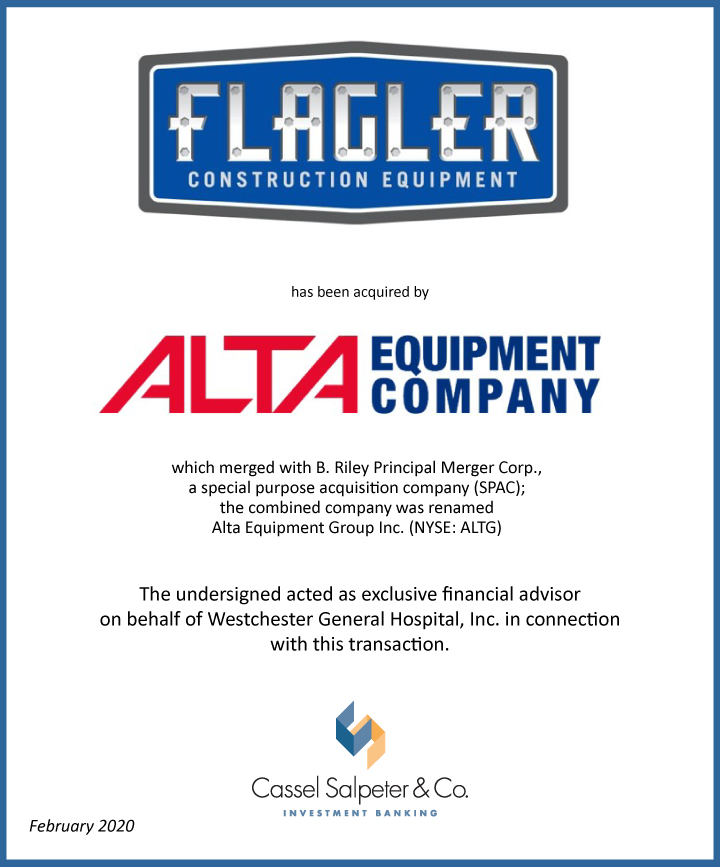
- Background: FlaglerCE Holdings, LLC (“Flagler”), founded in 2008 and based in Tampa, FL, engages in the sale, rental, and servicing of heavy construction equipment. Flagler has the exclusive rights to distribute Volvo Construction Equipment in the state of Florida. Flagler operates six main branches across Florida.
- Cassel Salpeter:
- Served as financial advisor to the Company
- Ran a competitive bidding process amongst a select group of potential buyers, maximizing proceeds for Flagler’s stakeholders
- Provided assistance throughout all phases of the sale process
- Challenges:
- Distressed operations with short timeline to close the deal
- Multi-constituent transaction that required the successful funding of a Special Purpose Acquisition Company (SPAC)
- Outcome: On February 14, 2020, Alta Equipment Company acquired Flagler.
- Alta Equipment Group Inc. owns and operates integrated equipment dealership platforms in the U.S. Alta Equipment Company merged with B. Riley Principal Merger Corp., a SPAC, and changed its name to Alta Equipment Group Inc.

China Has More Control Over Your Prescription Drugs Than You May Think
- Experts are expressing concerns over how much control China has over the U.S. pharmaceutical supply chain.
- They say China has a long-term strategy of lowering costs to drive
- U.S. drug manufacturing out of business.
- They also point out problems with the quality of drugs and ingredients from overseas, which was seen in last year’s recall of blood pressure
How you tackle a skin rash may become a matter of national security.
Most pharmaceuticals used in the United States are either made in nations such as China and India, or use ingredients that come from those countries.
Which means much of America’s collective health not only depends on diet and exercise, but also on our relations with those countries.
And during a time when terms like “trade war” are being thrown around daily, experts say it’s vital to understand all the possible consequences.
Even ones that might sound like something lifted from a Tom Clancy novel.
“If we had a pandemic and we needed drugs from another country, it could become a defense issue,” James Cassel, the co-founder of Cassel Salpeter & Co., which oversees mergers and acquisitions of healthcare companies, told Healthline. “It’s scary. Tariffs are one thing. But what if they just decide not to make something available?”
Other experts say there’s too much money at stake for countries like China to hold its drug manufacturing advantage over the United States, unless there’s an extreme confrontation.
“I feel this is highly unlikely, as the pharmaceutical industry in China is a priority industry and they need the U.S. orders and the U.S. technologies that often come with these contracts,” said Falguni Sen, PhD, director of the Global Healthcare Innovation Management Center at Fordham University’s business school in New York. “Can they do it? Sure they can. But I do not see any reason they would do that in pharma.”
A fragile supply chain
Nevertheless, as the rhetoric heats up between Washington and Beijing, the fragile nature of the pharmaceutical supply chain is being discussed at the highest levels of the U.S. government.
“The national security risks of increased Chinese dominance of the global API (active pharmaceutical ingredients) market cannot be overstated,” said Christopher Priest, the acting deputy assistant director for Healthcare Operations and TRICARE Health plan programs for the Defense Health Agency, which provides healthcare and prescription drugs to the military.
His comments came at a U.S.-China advisory panel in August.
“Basically, we’ve outsourced our entire industry to China,” retired Brig. Gen. John Adams told NBC earlier this month. “That is a strategic vulnerability. I think they know exactly what they’re doing and they’re incredibly good strategists. They’re doing this, they select their industries for the future and they’ve got a plan.”
That plan is a long-term approach to pricing, said David Jacobson, MBA, JD, who teaches global business strategy at Southern Methodist University in Texas and is a visiting professor at Tsinghua University in Beijing.
Because the U.S. system is based on finding the supplier with the lowest costs, he said China uses that to its advantage.
“At first glance this may seem great because it lowers the cost for consumers, at least temporarily,” Jacobson, who has testified before federal panels on China’s state-owned enterprises, told Healthline. “But Americans, from the government to consumers, play a very short timeline game. Our rivals in China are far better at using a long-term approach. So China allows pharmaceutical pricing to become so low that it drives Western companies out of the manufacturing business.”
So, wouldn’t the United States be grateful China keeps manufacturing costs low?
Jacobson said that’s part of China’s plan.
“They are making strategic decisions to drive us out of business so that they have strategic control over critical supplies of drugs and drug companies,” he said. “The entire USA healthcare system market for generic drugs has moved offshore, primarily to China. Virtually no one is making generics in the USA. Most drugs utilized in the USA are generics. Now we are very vulnerable.”
Controlling the supply
Jacobson said the system keeps the United States at China’s mercy in the event of a health crisis, even if China doesn’t have ill intent.
“What if a large-scale health problem is confronting the population of the USA and China at the same time? China will prioritize its population at the cost of ours,” he said.
Controlling our pharma supply also means China can withhold supplies just to affect our markets, which Jacobson said is even more dangerous.
“Bright-thinking U.S.-based healthcare communities are seeing this dynamic and working to bring back generic manufacturing and component manufacturing as a national security issue because of the danger of being so dependent on a rival for our well-being,” he said.
We got a glimpse of what a supply chain crunch could look like last year when Hurricane Maria’s damage in Puerto Rico caused a shortage of IV saline bags in the United States.
However, even if China doesn’t intentionally tamper with the supply flow, problems can arise.
“There have been supply chain problems in the past,” Yali Friedman, PhD, an author and founder of DrugPatentWatch.com, told Healthline.
Friedman pointed to the contamination Trusted Source of the blood thinner heparin in 2007 and 2008 that resulted in the deaths of 149 people in the United States.
The Food and Drug Administration responded by stationing inspectors overseas.
There’s also the recall of blood pressure medications that began in July 2018 due to a contaminant in ingredients made in China and India.
“Constant vigilance is essential to ensure the safety of these medicines,” Friedman said. “Supply chain safety is something which regulators are aware of and they are constantly seeking to stay ahead of threats.”
Even then, there’s problems with quality in China, Jacobson said.
“The upper middle class and wealthy population of China never use a generic produced because they know the quality control is so weak. They always buy Western brand-name pharma products to protect themselves and their family,” he said.
Sen told Healthline there are other problems with the supply chain, including other countries not having enough inspectors, lack of control over the manufacturing sites, and “natural disasters, such as earthquakes, hurricanes and fires.”
Even having enough penicillin could be problematic because the last penicillin manufacturing plant in the United States closed in 2004.
Again, it all comes down to cost, said Sen.
The manufacturing issue
Sen says U.S. drug companies prefer to spend money on developing new drugs, rather than manufacturing them.
“Manufacturing has a different culture from one of being focused on drug discovery and marketing,” he said. “Managing two different cultures is very difficult, and if you did not have to do it, you would avoid it.”
So, if economic incentive won’t bring drug manufacturing back to the United States, what will?
“I see it not as an economic concern, but more of a national security concern,” said Sen. “I hope we will have some key manufacturing capabilities in this country to particularly manufacture vaccines when needed and not have to depend on other countries to help us deal with epidemics.”
Two House Democrats from California co-authored an opinion piece on the matter earlier this month in the Washington Post.
Adam Schiff and Anna Eshoo pointed out that if current economic conditions with China further erode, the Chinese could seek “pressure points” to leverage against the U.S. in pharma manufacturing.
Costs could surge or China could manipulate shortages. They wrote that they plan to hold hearings soon.
“We should not be held hostage by any foreign country,” Eshoo told NBC.
Click here to read the PDF.
Broward Attorney Accused of Helping Company Defraud Investors
September 18, 2019
By Brian Bandell
Federal prosecutors have accused Fort Lauderdale attorney Jan Douglas Atlas of helping 1 Global Capital LLC defraud more than 3,600 investors.
The Securities and Exchange Commission also filed a civil lawsuit against Atlas over securities law violations involving 1 Global Capital.
The Hallandale Beach-based financial company, which provided loans to small businesses, filed Chapter 11 in U.S. Bankruptcy Court in 2018. Soon after, the SEC filed civil fraud charges against 1 Global Capital and former CEO Carl Ruderman, alleging they fraudulently raised $322 million from investors.
In August, former 1 Global Capital CFO Alan G. Heide pleaded guilty to criminal fraud charges for authorizing false financial documents for company. He will be sentenced Dec. 12.
In the latest development, Atlas was charged with securities fraud in federal court in Miami on Tuesday. As outside counsel for 1 Global Capital, Atlas authored a legal opinion he allegedly knew was false: that the company’s investment products were not a securities offering as regulated by the SEC, according to court documents.
“Jan is a good man who had a wonderful, successful career. But like all of us, he wasn’t perfect,” said Anita Margot Moss, his attorney in the criminal case. “He has quickly accepted responsibility for his actions in this case and shown genuine remorse. He will do everything he can to make this right.”
Atlas and his attorney, Anita Margot Moss, couldn’t be reached for comment.
Prosecutors said Atlas was paid $627,000 for his services to 1 Global. They asked that any funds Atlas received from fraudulent activity be forfeited, court documents said.
If found guilty, Atlas could face up to five years in prison.
According to the SEC lawsuit, 1 Global overstated the value of investors’ accounts and their rate of returns, and misappropriated at least $32 million to personally benefit Ruderman. Because the company allegedly relied on Atlas’ false opinion letters when attracting investors, the SEC charged Atlas with aiding and abetting securities law violations. He could face civil penalties.
“Atlas disregarded his position as a gatekeeper and instead issued opinion letters containing false information, enabling 1 Global to continue its illegal offer and sale of notes to retail investors,” said Eric I. Bustillo, director of the SEC’s Miami office. “We allege that Atlas was able to profit handsomely for his role, wrongly receiving hundreds of thousands of dollars of investor money.”
To settle the SEC lawsuit, Ruderman agreed to disgorge $32 million in ill-gotten gains, pay a $15 million civil penalty, turn over $750,000 in cash and give the SEC a 50% interest in his condominium. He was also barred from working in the securities industry.
Cassel Salpeter Chairman James Cassel, who was appointed director of 1 Global’s estate in bankruptcy court, said about $100 million will be recovered to repay investors and settle lawsuits. Investors will receive about 30 cents on the dollar, he said. Any money the SEC recovers from Ruderman as part of its settlement with him would be paid to investors on top of that amount, Cassel added.
Going forward, 1 Global will pursue more litigation claims and continue to collect on its loans from businesses, said Greenberg Traurig attorney Paul Kreen, who represents the debtor.
Click here to read the PDF.