


Grounded Growth. How Supply Chain Constraints Are Redefining Aviation
By Joey Smith
July 14, 2026
The aviation industry has entered a new era defined not by a lack of demand, but by a lack of supply. Airlines are eager to expand fleets, passenger traffic continues to recover and grow, and cargo demand remains strong. Yet aircraft manufacturers, engine Original Equipment Manufacturers (OEMs), maintenance providers, and suppliers are struggling to keep pace.
Aircraft Deliveries
The industry’s aircraft order backlog/book now exceeds 17,000 aircraft (attributed to Boeing & Airbus), representing about 60% of the active global fleet, while engine and maintenance bottlenecks continue to constrain growth, forcing carriers to keep older aircraft in service longer. This massive order backlog/book translates to roughly 12 years of production capacity. While output is stabilizing and hitting multi-year highs, component shortages and regulatory scrutiny continue to bottleneck fulfillment speeds. The supply chain crisis has forced airlines to incur more than $11 billion in additional costs, including Maintenance, Repair, and Overhaul (MRO) expense increases, leasing engines, and spare-parts stockpiling of Used Serviceable Material (USM) and other components.
Engine Shortages
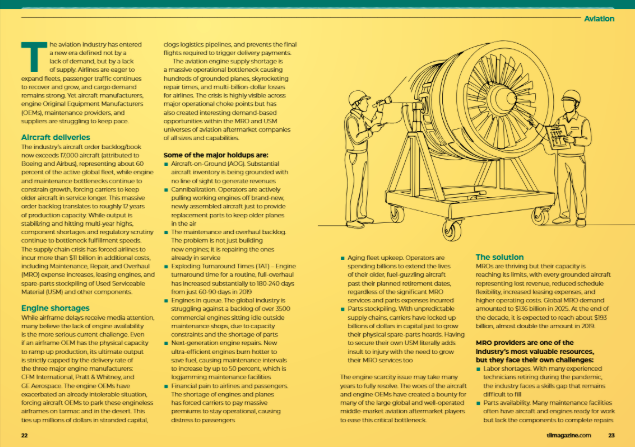
While airframe delays receive media attention, many believe the lack of engine availability is the more serious current challenge. Even if an airframe OEM has the physical capacity to ramp up production, its ultimate output is strictly capped by the delivery rate of the three major engine manufacturers: CFM International, Pratt & Whitney, and GE Aerospace. The engine OEMs have exacerbated an already intolerable situation, forcing the aircraft OEMs to park these engineless airframes on tarmac and in the desert. This ties up millions of dollars in stranded capital, clogs logistics pipelines, and prevents the final flights required to trigger delivery payments.
The aviation engine supply shortage is a massive operational bottleneck causing hundreds of grounded planes, skyrocketing repair times, and multi-billion-dollar losses for airlines. The crisis is highly visible across major operational choke points but has also created interesting demand-based opportunities within the MRO and USM universes of aviation aftermarket companies of all sizes and capabilities. Some of the major holdups are:
- Aircraft-on-Ground (AOG). Substantial aircraft inventory is being grounded with no line of sight to generate revenues
- Cannibalization. Operators are actively pulling working engines off brand-new, newly assembled aircraft just to provide replacement parts to keep older planes in the air
- The maintenance and overhaul backlog. The problem is not just building new engines; it is repairing the ones already in service
- Exploding Turnaround Times (TAT). Engineturnaround time for a routine, full-overhaul has increased substantially to 180-240 days from just 60-90 days in 2019
- Engines in queue. The global industry is struggling against a backlog of over 3,500 commercial engines sitting idle outside maintenance shops, due to capacity constraints and the shortage of USM/parts
- Next generation engine repairs. New ultra-efficient engines burn hotter to save fuel, causing maintenance intervals to increase by up to 50%, which is logjamming maintenance facilities
- Financial pain to airlines and passengers. The shortage of engines and planes has forced carriers to pay massive premiums to stay operational, causing distress to passengers
- Aging fleet upkeep. Operators are spending billions to extend the lives of their older, fuel-guzzling aircraft past their planned retirement dates, regardless of the significant MRO services and USM/parts expenses incurred
- Parts stockpiling. With unpredictable supply chains, carriers have locked up billions of dollars in capital just to grow their physical spare-parts hoards. Having to secure their own USM literally adds insult to injury with the need to grow their MRO services too
We believe that this engine scarcity issue may take many years to fully resolve. The woes of the aircraft and engine OEMs have created a bounty for many of the large global and well-operated middle-market aviation aftermarket players to ease this critical bottleneck.
The solution
MROs are thriving but their capacity is reaching its limits, with every grounded aircraft representing lost revenue, reduced schedule flexibility, increased leasing expenses and higher operating costs. Global MRO demand amounted to $136 billion in 2025. By the end of the decade, it is expected to reach about $193 billion, almost double the amount in 2019.
MRO providers are one of the industry’s most valuable resources, but they face their own challenges:
- Labor shortages. With many experienced technicians retiring during the pandemic, the industry faces a skills gap that remains difficult to fill
- Parts availability. Many maintenance facilities often have aircraft and engines ready for work but lack the components to complete repairs
- Capacity constraints. Increasingly, facilities are booked months or even years in advance for certain engine programs
This environment has increased the value of established MRO providers and created opportunities for expansion and acquisition activity.
One of the most significant trends emerging from the supply chain crisis is the growing importance of USM, which refers to components harvested from retired aircraft and certified for continued use.The USM market size was about $7.6 billion in 2025 and is projected to exceed $10.8 billion in 2033. It is growing so rapidly because it allows for faster availability than new parts, lower acquisition cost, improved supply reliability, and reduced aircraft downtime.
The industry’s implementation plan
Industry participants are adapting in numerous ways, with the focus shifted from efficiency to resilience. Two increasingly important aftermarket tools are Parts Manufacturer Approval (PMA) parts, which are FAA-approved replacement or modification parts, and Designated Engineering Representative (DER) repairs, which are FAA-approved, engineered repair solutions.
Airlines are extending fleet life, diversifying suppliers, increasing spare engine inventories and USM, and securing long-term MRO maintenance agreements.
Lessors are retaining aircraft longer, expanding engine leasing portfolios, and investing in aftermarket capabilities for mid- to end-of-life aircraft/engine extension.
MRO providers are expanding facilities, recruiting and training technicians, increasing capacity for PMA parts and DER repairs and pursuing acquisitions to add capacity.
Suppliers are increasing USM inventory levels, utilizing alternative sourcing strategies for PMA parts and DER repairs, and nearshoring critical production.
The bottom line
While manufacturing output is gradually improving, the supply chain and structural challenges discussed remain pervasive throughout the aviation ecosystem. We believe that meaningful improvement will be incremental, as organizations that successfully adapt to this environment by strengthening supply chains, expanding aftermarket capabilities, and improving workforce and operational flexibility will be best positioned to capitalize on aviation’s continued growth.
As we continue to expect supply chain pressures to persist in the coming years, access to aircraft, engines, and parts has become just as important as access to customers. The aviation industry’s greatest challenge today is not generating demand, but meeting it.

Click here to read the full article.

