
Q3 2026 Tech Review
Miami Investment Banking Firm Cassel Salpeter Issues Tech Industry Deal Report
South Florida firm publishes Q3 2026 Tech Review surveying year’s company M&A, deal flow, and market trends


Miami Investment Banking Firm Cassel Salpeter Issues Tech Industry Deal Report
South Florida firm publishes Q3 2026 Tech Review surveying year’s company M&A, deal flow, and market trends
MIAMI – October 7, 2026 – Cassel Salpeter & Co., an independent investment banking firm that provides advisory services to middle-market and emerging growth companies, announced the promotions of Marcus Wai and Chris Mansueto to senior vice president, and Edward “Eddie” Kropf and Charles Davis to vice president.
“Our clients trust us with some of the most consequential decisions they’ll ever make, and that trust is earned by people who know their businesses and see the work through to the end,” said James S. Cassel, chairman and co-founder of Cassel Salpeter. “Developing our own talent is how we make sure that standard carries forward as the firm grows, and we are proud to announce the promotions of Marcus, Chris, Eddie, and Charles.”
About Cassel Salpeter & Co.:
Cassel Salpeter & Co. LLC is an independent investment banking firm providing advice to middle-market and emerging growth companies in the United States and worldwide. The firm’s senior professionals have more than 150 years of combined experience advising private and public companies on a broad range of investment banking and financial advisory services, including mergers and acquisitions; equity and debt capital raises; fairness and solvency opinions; valuations; and restructurings, including 363 sales and plans of reorganization.
Co-founded by James S. Cassel and Scott Salpeter, the firm provides objective, unbiased, results-focused services grounded in rigorous analysis and insight aligned with each client’s objectives. The firm’s senior professionals are involved at every stage of each engagement and have built long-standing relationships and completed hundreds of transactions and assignments nationwide.
The firm’s headquarters are in Miami. Member FINRA and SIPC. More information is available at www.CasselSalpeter.com.
 MIAMI – September 22, 2026 – Cassel Salpeter & Co., an independent investment banking firm that provides advisory services to middle-market and emerging growth companies, served as the exclusive financial advisor to The Xtreme Group (“TXG”) in its sale to Heartwood Partners.
Founded in 2013, TXG is a leading independent, full-service aviation maintenance, repair, and overhaul (MRO) platform based in Miami. The transaction encompasses TXG’s key subsidiaries: Xtreme Aviation LLC, an FAA Part 145 certificated airframe and line maintenance provider; Ignite Aero Engines, an FAA Part 145 engine MRO specializing in CFM56 and CFM34 engines; and Aventus Air Leasing II, which focuses on the sale and leasing of aircraft and engines.
The acquisition supports TXG’s long-term growth strategy of expanding into new markets, generating further synergies between its complementary lines of business, and providing a single-source MRO solution that eliminates delays often associated with outside vendors.
Heartwood Partners is a Norwalk, Connecticut-based private equity firm founded in 1982. This transaction represents a new platform investment for Heartwood in the aviation sector.
“TXG has built a true single-source platform spanning airframe, engine, and leasing capabilities – exactly the kind of durable, diversified aviation business that’s prime for investment right now, and we’re pleased to have advised them in this transaction with the team at Heartwood,” said Joey Smith, director of Aviation Services at Cassel Salpeter. “We’re confident that Heartwood is an ideal partner to support TXG’s continued growth and long-term success.”
“The Cassel Salpeter team was an integral part of our new partnership with Heartwood,” said TXG Chief Executive Officer Carlos Cock. “From making the original introduction to driving the process along every step of the way, they took the time to properly understand our company and how we could create additional value for our stakeholders and our industry.”
The Cassel Salpeter team was led by President Scott Salpeter and Director of Aviation Services Joey Smith, with assistance from Senior Associate Eddie Kropf.
Brad West and Fern Watts of West PLC served as legal counsel to the seller.
Heartwood Partners has been advised by Finn Dixon & Herling LLP and Greenberg Traurig, LLP.
About Cassel Salpeter & Co.:
Cassel Salpeter & Co. LLC is an independent investment banking firm providing advice to middle market and emerging growth companies in the United States and worldwide. The firm’s professionals have more than 150 years of combined experience advising private and public companies on a broad range of investment banking and financial advisory services, including mergers and acquisitions; equity and debt capital raises; fairness and solvency opinions; valuations; and restructurings, including 363 sales and plans of reorganization.
Co-founded by James S. Cassel and Scott Salpeter, the firm provides objective, unbiased, results-focused services grounded in rigorous analysis and transaction-specific insight aligned with each client’s objectives. The firm’s partners are personally involved at every stage of each engagement and have built long-standing relationships and completed hundreds of transactions and assignments nationwide.
The firm’s headquarters are in Miami. Member FINRA and SIPC. More information is available at www.CasselSalpeter.com.
By Anastasiya Simsek
August 7, 2026
A global shortage of aircraft, engines and spare parts is reshaping the aviation industry, with airlines increasingly extending the life of existing fleets and redirecting investment towards maintenance, repair and overhaul (MRO) rather than new aircraft, according to a new report by aviation investment banking firm Cassel Salpeter & Co. The report, Supply Chain Constraints Are Reshaping Aviation, said global commercial aircraft backlogs have exceeded 17,000 aircraft, equivalent to around 12 years of production at current manufacturing rates. Despite strong demand driven by fleet expansion, recovering passenger traffic and resilient cargo markets, manufacturers and suppliers continue to struggle to keep pace.
Cassel Salpeter estimates airlines incurred more than $11 billion in additional supply chain-related costs in 2025, including higher maintenance expenses, leased engines and spare parts stockpiling. Airbus and Boeing remain dependent on engine deliveries from suppliers including CFM, Pratt & Whitney and GE Aerospace, while next-generation GTF and LEAP engines are requiring more frequent maintenance due to durability issues.
The report notes that around 60 completed Airbus aircraft remained without engines during 2025, while more than 3,500 commercial engines are awaiting castings, forgings and other components. Engine overhaul turnaround times have also increased significantly, rising from 60-90 days in 2019 to between 180 and 240 days today.
According to Cassel Salpeter, the shortages are driving airlines to retain older aircraft beyond planned retirement dates, increasing demand for engine leasing, spare parts and maintenance services while reducing operational flexibility.
Also global MRO spending will increase from a record of approximately $136 billion in 2025 to around $193 billion by 2036, with engine maintenance remaining the largest segment. Engine-related MRO spending alone is expected to account for roughly $103 billion by 2036. Beyond traditional maintenance, the report highlights growing demand for alternative aftermarket solutions. The market for Used Serviceable Material (USM) is projected to grow from around $8 billion in 2025 to more than $10.8 billion by 2033, while the Parts Manufacturer Approval (PMA) market is expected to expand from approximately $11.8 billion to more than $16.1 billion by 2034. Demand for Designated Engineering Representative (DER) repairs is also increasing as operators seek to extend component life and reduce dependence on original equipment manufacturers.
Cassel Salpeter said airlines are responding by extending fleet life, increasing spare engine inventories, diversifying suppliers and securing long-term maintenance agreements. MRO providers are expanding facilities and technician recruitment, while suppliers are increasing inventories and turning to alternative sourcing strategies. It concludes that supply chain constraints are likely to persist for several years, with access to aircraft, engines, parts and maintenance capacity becoming as strategically important as access to customers.

Click here to read the full article.

By Joey Smith
July 14, 2026
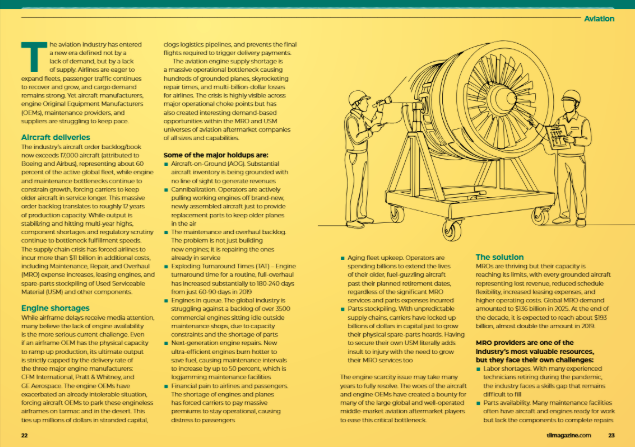
The aviation industry has entered a new era defined not by a lack of demand, but by a lack of supply. Airlines are eager to expand fleets, passenger traffic continues to recover and grow, and cargo demand remains strong. Yet aircraft manufacturers, engine Original Equipment Manufacturers (OEMs), maintenance providers, and suppliers are struggling to keep pace.
Aircraft Deliveries
The industry’s aircraft order backlog/book now exceeds 17,000 aircraft (attributed to Boeing & Airbus), representing about 60% of the active global fleet, while engine and maintenance bottlenecks continue to constrain growth, forcing carriers to keep older aircraft in service longer. This massive order backlog/book translates to roughly 12 years of production capacity. While output is stabilizing and hitting multi-year highs, component shortages and regulatory scrutiny continue to bottleneck fulfillment speeds. The supply chain crisis has forced airlines to incur more than $11 billion in additional costs, including Maintenance, Repair, and Overhaul (MRO) expense increases, leasing engines, and spare-parts stockpiling of Used Serviceable Material (USM) and other components.
Engine Shortages
While airframe delays receive media attention, many believe the lack of engine availability is the more serious current challenge. Even if an airframe OEM has the physical capacity to ramp up production, its ultimate output is strictly capped by the delivery rate of the three major engine manufacturers: CFM International, Pratt & Whitney, and GE Aerospace. The engine OEMs have exacerbated an already intolerable situation, forcing the aircraft OEMs to park these engineless airframes on tarmac and in the desert. This ties up millions of dollars in stranded capital, clogs logistics pipelines, and prevents the final flights required to trigger delivery payments.
The aviation engine supply shortage is a massive operational bottleneck causing hundreds of grounded planes, skyrocketing repair times, and multi-billion-dollar losses for airlines. The crisis is highly visible across major operational choke points but has also created interesting demand-based opportunities within the MRO and USM universes of aviation aftermarket companies of all sizes and capabilities. Some of the major holdups are:
We believe that this engine scarcity issue may take many years to fully resolve. The woes of the aircraft and engine OEMs have created a bounty for many of the large global and well-operated middle-market aviation aftermarket players to ease this critical bottleneck.
The solution
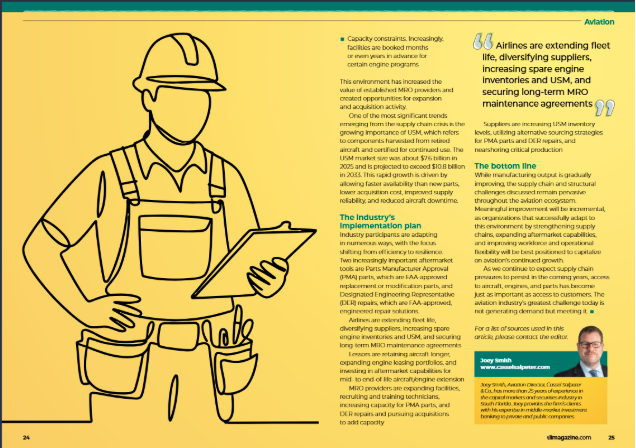
MROs are thriving but their capacity is reaching its limits, with every grounded aircraft representing lost revenue, reduced schedule flexibility, increased leasing expenses and higher operating costs. Global MRO demand amounted to $136 billion in 2025. By the end of the decade, it is expected to reach about $193 billion, almost double the amount in 2019.
MRO providers are one of the industry’s most valuable resources, but they face their own challenges:
This environment has increased the value of established MRO providers and created opportunities for expansion and acquisition activity.
One of the most significant trends emerging from the supply chain crisis is the growing importance of USM, which refers to components harvested from retired aircraft and certified for continued use.The USM market size was about $7.6 billion in 2025 and is projected to exceed $10.8 billion in 2033. It is growing so rapidly because it allows for faster availability than new parts, lower acquisition cost, improved supply reliability, and reduced aircraft downtime.
The industry’s implementation plan
Industry participants are adapting in numerous ways, with the focus shifted from efficiency to resilience. Two increasingly important aftermarket tools are Parts Manufacturer Approval (PMA) parts, which are FAA-approved replacement or modification parts, and Designated Engineering Representative (DER) repairs, which are FAA-approved, engineered repair solutions.
Airlines are extending fleet life, diversifying suppliers, increasing spare engine inventories and USM, and securing long-term MRO maintenance agreements.
Lessors are retaining aircraft longer, expanding engine leasing portfolios, and investing in aftermarket capabilities for mid- to end-of-life aircraft/engine extension.
MRO providers are expanding facilities, recruiting and training technicians, increasing capacity for PMA parts and DER repairs and pursuing acquisitions to add capacity.
Suppliers are increasing USM inventory levels, utilizing alternative sourcing strategies for PMA parts and DER repairs, and nearshoring critical production.
The bottom line
While manufacturing output is gradually improving, the supply chain and structural challenges discussed remain pervasive throughout the aviation ecosystem. We believe that meaningful improvement will be incremental, as organizations that successfully adapt to this environment by strengthening supply chains, expanding aftermarket capabilities, and improving workforce and operational flexibility will be best positioned to capitalize on aviation’s continued growth.
As we continue to expect supply chain pressures to persist in the coming years, access to aircraft, engines, and parts has become just as important as access to customers. The aviation industry’s greatest challenge today is not generating demand, but meeting it.

Click here to read the full article.

Miami Investment Banking Firm Cassel Salpeter Issues Healthcare Industry Deal Report
South Florida firm publishes Q2 2026 Healthcare Deal Report surveying year’s company M&A, deal flow, and market trends.

Miami Investment Banking Firm Cassel Salpeter Issues Tech Industry Deal Report
South Florida firm publishes Q2 2025 Tech Deal Report surveying year’s company M&A, deal flow, and market trends

Miami Investment Banking Firm Cassel Salpeter Issues Aviation Industry Deal Report
South Florida firm publishes Q2 2026 Aviation Deal Report surveying company M&A, deal flow, and market trends

By Mark Dovich – Reporter, South Florida Business Journal
July 14, 2026
Officials in Miami have approved measures to advance the long-planned revamp of the historic Coconut Grove Playhouse.
At a July 9 meeting, members of Miami’s City Commission approved a resolution granting Miami-Dade County the needed zoning exceptions and waivers to redevelop the building, overriding a recommendation from the city’s Planning, Zoning and Appeals Board.
That sets the stage for the revitalization of the property, at 3498 and 3500 Main Highway in Miami’s Coconut Grove neighborhood.
The plan calls for the construction of a new 310-seat theater that preserves the 99-year-old building’s historic facade, plus about 6,400 square feet of ground-floor retail and restaurants, 31,000 square feet of offices and a 289-space parking garage.
The property, owned by the state of Florida, occupies a roughly 2.5-acre lot on the boundary between central Coconut Grove and the historically Black West Grove part of the neighborhood.
Miami-Dade County’s budget for fiscal years 2025-2026 estimates the cost of reconstructing the Coconut Grove Playhouse at $58.4 million.
The theater shuttered in 2006 and has since fallen into disrepair. There’s been talk of revitalization, but efforts to revamp the property have been stalled by years of litigation.
There’s also been local pushback to redevelopment efforts, with critics citing a desire to preserve Coconut Grove’s distinctive character, as well as concerns over gentrification in the West Grove area.
On the other hand, proponents say a revamped theater could draw more visitors to the area and provide a boost to nearby retailers, restaurants and other businesses.
“It’s been 20 years, and it’s really hurt the Grove not being open, because it’s a draw. When people go to the theater, they go to dinner and walk around. … It really helps the businesses,” said James Cassel, chair and co-founder of Miami-based investment bank Cassel Salpeter & Co.
Speaking with the Business Journal, he said he expected more public parking would also help lift nearby businesses.
“There is a real shortage of parking today in Center Grove. … Sometimes people don’t come to the Grove because parking’s a problem, and that hurts business,” said Cassel, who also serves on the board of the Miami Parking Authority and has closely tracked the issue. “Having the parking and theater there will serve Grove residents and the Grove business district well.”
A detailed timeline for the redevelopment of the Coconut Grove Playhouse wasn’t immediately available.
In recent years, there’s been an influx of billionaires, executives and other high-net-worth residents to Coconut Grove. Those shifting demographics have contributed to a surge in demand for luxury residences and offices in the neighborhood.
Click here to read the full article.